A Method for the Baroque Lute Based on Historical Sources

- 1. A Fragmented Pedagogical Tradition
- 2. Rhetoric as the Governing Principle of Baroque Performance
- 3. Historical Sources and Musicological Foundations
- 4. Technical Foundations: Right Hand, Posture, and Instrumental Gesture
- 5. The Idiom of the Baroque Lute: Tuning, Resonance, and Damping
- 6. Peter Croton — Fundamental Principles of the Baroque Lute
- 7. Musical Language and Rhetorical Expression
- 8. Pedagogical Architecture and Learning Trajectory
- 9. Basso Continuo and Ensemble Practice
- 10. A Distinct Contribution to Modern Lute Pedagogy
- 11. Conclusion: Technique in the Service of Rhetoric
- 12. A Method for the Baroque Lute Based on Historical Sources
A Fragmented Pedagogical Tradition

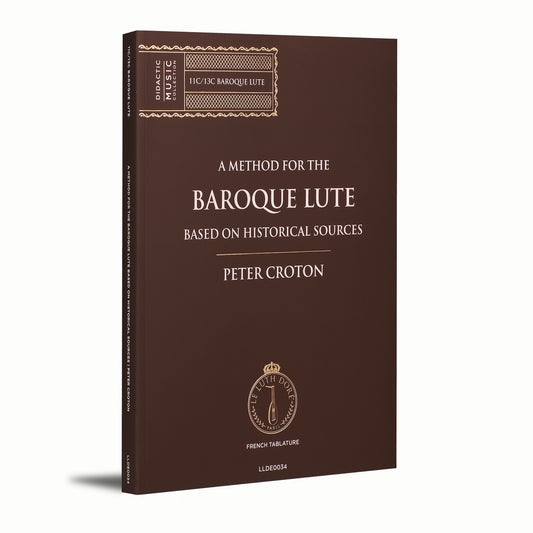
The pedagogical landscape for the baroque lute has long remained fragmented, oscillating between archival transcriptions of primary sources and introductory manuals that frequently lack a sustained musicological foundation. In this context, A Method for the Baroque Lute Based on Historical Sources by Peter Croton occupies a distinctive position.
Conceived not as a primer but as an intensive tutor, the work seeks to bridge the persistent dividebetween historical theory and practical execution. Within the broader tradition of lute pedagogy, the method rests on the premise that performance practice from the mid-sixteenth to the late eighteenth century was fundamentally governed by the primacy of rhetoric.
Technique, accordingly, is not presented as an autonomous goal, but as the means by which musical intention, conceived rhetorically, may be realised in sound.
Peter Croton’s opus magnum, A Method for the Baroque Lute Based on Historical Sources, may well stimulate the necessary and long-awaited discussion within the lute community.
Extending to 336 pages, this long-anticipated volume undertakes nothing less than the task of repositioning the instrument within its historical context and, beyond that, of proposing a coherent methodology capable of fostering a lasting evolution in the world of the lute.
The book offers a systematic presentation of the current state of research and—firmly oriented toward practice—sets forth a “new” (that is, historically grounded) approach to playing, based on our present knowledge of historical and organological sources, while developing these insights for practical instrumental application.
Anyone genuinely interested in a historically informed approach to the New Ordinary Tuning—now somewhat superficially referred to as the “baroque lute”—will find it difficult to avoid investing in this publication. Written in clear English and carefully produced, the book is therefore strongly recommended to all serious performers engaged with the eighteenth-century lute repertoire

Rhetoric as the Governing Principle of Baroque Performance

The author’s methodological stance emerges from a profile that unites active performance, long-standing pedagogical experience, and close engagement with historical sources. Having taught at institutions such as the Schola Cantorum Basiliensis, Peter Croton frames technique as “the Great Enabler”: a functional apparatus whose sole purpose is to give material form to what is already imagined musically.
This conception aligns the method with early modern aesthetic thought, in which musical execution was valued not for mechanical display but for its capacity to move the listener’s passions through clarity, proportion, and affective contrast. Rhetoric, rather than virtuosity, thus constitutes the organising principle of musical expression.
Historical Sources and Musicological Foundations
The historical foundations of the method rest upon a rigorous synthesis of seventeenth- and eighteenth-century treatises and manuscripts. Central among these are Ernst Gottlieb Baron’s Historisch-Theoretisch und Practische Untersuchung des Instruments der Lauten and Thomas Mace’s Musick’s Monument, alongside pedagogical documents such as Miss Mary Burwell’s Instruction Book for the Lute and the writings of Marin Mersenne.

Rather than extracting isolated rules, the method reconstructs a coherent aesthetic framework by allowing these sources to illuminate one another. References extend from the rhetorical ideals of the Florentine Camerata and its stile rappresentativo to the galant-era reflections of Johann Joachim Quantz in his Versuch einer Anweisung die Flöte traversiere zu spielen, demonstrating the continuity of rhetorical thinking across instrumental traditions.
A defining feature of the work is its refusal to normalise or modernise historical discourse. Vernacular terminology and non-standardised spellings are preserved where they convey essential conceptual distinctions, and technical advice is derived from the priorities articulated by historical practitioners themselves.

Technical Foundations: Right Hand, Posture, and Instrumental Gesture
The technical approach advocated in the method is characterised by its reliance on anatomical efficiency as understood through historical precedent, particularly with regard to right-hand placement and plucking mechanics. Central to this approach is the so-called “thumb-out” position and the placement of the little finger near the bridge, both supported by iconographic and written evidence from the seventeenth and eighteenth centuries.

Plucking is described as originating from the coordinated use of the base joints, allowing speed and precision without unnecessary tension. These principles are not presented as abstract physiology but as practical observations grounded in historical descriptions of ease, grace, and natural motion.
Posture is approached with similar rigour. An upright seated or standing position, supported by a strap, is advocated to facilitate balance, free breathing, and economical use of the body. Physical comportment thus becomes inseparable from musical delivery.

The Idiom of the Baroque Lute: Tuning, Resonance, and Damping

The specific idiom of the baroque lute receives sustained attention. The complexities of d-minor tuning, the presence of extended bass courses, and the resulting resonance patterns are addressed with particular care. The necessity of dampening bass strings to preserve harmonic clarity is treated not as a corrective technique, but as an integral component of articulation in polyphonic textures.
Here, instrumental technique is shown to arise directly from the acoustic properties of the instrument itself, rather than from abstract mechanical ideals.
Peter Croton — Fundamental Principles of the Baroque Lute
Musical Language and Rhetorical Expression
Musical language throughout the method is inextricably linked to rhetorical thought. Phrasing, articulation, and dynamics are consistently framed as expressive tools whose purpose is to move the listener’s affections. The interplay of consonance and dissonance is treated as a primary determinant of dynamic shaping: dissonant events demand emphasis in order to stir the passions, while their resolution into consonance restores equilibrium.
Rhythmic flexibility is presented as a further manifestation of rhetorical performance. Pan-European practices of rhythmic inequality, including the codified French notes inégales, impart vitality and direction to melodic lines. Ornamentation is treated within the same rhetorical framework: short graces, such as appoggiaturas, function as incisive expressive devices rather than decorative excess.
Tableau de synthèse conceptuelle
| Rhetorical axis | Core principle | Expressive function |
| Rhetorical thinking | Musical language is inseparable from rhetoric | Music is conceived as a discourse intended to act upon the listener |
| Phrasing – articulation – dynamics | Parameters understood as expressive tools | Organisation of musical discourse for rhetorical expression |
| Consonance / dissonance | Structuring interaction within the discourse | Dissonance generates tension; consonance restores equilibrium |
| Dynamic shaping | Hierarchisation of musical events | Dissonant events require expressive emphasis |
| Rhythmic suppleness | Essential dimension of rhetorical performance | Vitality, direction, and breathing of musical discourse |
| Rhythmic inequality | Historically attested pan-European practices | Reinforcement of melodic direction and expressiveness |
| Ornamentation | Integrated within the rhetorical framework | Short ornaments (appoggiaturas) function as incisive expressive devices |
| Expressive aim | To move the listener’s affections | Music seeks emotional action rather than decoration |
Pedagogical Architecture and Learning Trajectory
The pedagogical philosophy underlying the method is articulated through a progressive structure that gradually reduces explicit instruction in favour of informed autonomy. Initial sections offer detailed guidance, while later stages adopt a deliberately restrained editorial voice, inviting the student to assume responsibility for interpretive decisions.

The method is explicitly addressed to players who already possess prior experience with lute-family instruments or the classical guitar. Emphasis is placed on the learning process itself rather than on the accumulation of repertoire, and students are encouraged to engage directly with historical manuscripts beyond the material provided.
Basso Continuo and Ensemble Practice

The inclusion of an introduction to basso continuo on the d-minor tuned baroque lute extends the scope of the work beyond solo performance. By equipping students with the technical and stylistic tools necessary for continuo playing, the method situates the baroque lute within its broader musical ecosystem and reinforces its collaborative function.

A Distinct Contribution to Modern Lute Pedagogy
Within the field of modern lute pedagogy, this work distinguishes itself through its sustained integration of physical efficiency and rhetorical expression. Where other methods may privilege repertoire or stylistic generalities, Croton’s approach insists upon the mutual dependency of gesture and meaning.

Conclusion: Technique in the Service of Rhetoric
The scholarly and pedagogical significance of A Method for the Baroque Lute Based on Historical Sources lies in its holistic synthesis of archival research and embodied practice. Rather than teaching the mechanics of the instrument in isolation, Peter Croton offers a pathway toward understanding the baroque lute as a rhetorical medium.
By grounding every technical instruction in documented historical practice, the method establishes itself as a primary reference for the study of the instrument. Ultimately, it dissolves the perceived boundary between technique and interpretation, proposing a model of performance that is at once stylistically faithful and expressively compelling.

A Method for the Baroque Lute Based on Historical Sources
€129,95 EUR

Peter Croton is a Swiss-American lutenist, pedagogue, and scholar, internationally recognised for his commitment to the rediscovery and transmission of historical performance practices. Following his studies in the United States and Europe, he established himself as one of the leading performers and teachers of the lute and theorbo, both as a soloist and as an accompanist.
He taught for many years at the Schola Cantorum Basiliensis in Basel and at the Hochschule der Künste Bern, where he trained several generations of lutenists and continuo players. His activity as a concert performer and recording artist — praised by the international press — is inseparable from a deep and sustained reflection on musical rhetoric and pedagogy.
Author of several reference works, including A Method for the Renaissance Lute and A Method for the Baroque Lute, published by Le Luth Doré Urtext Editions, he continues to pursue a body of work situated at the intersection of historical research and artistic expression, faithful to the humanist ideals of early music.
This thoughtful and progressive guide to learning the baroque lute addresses every aspect of the instrument, from history and technique to kinesiology and interpretation. An indispensable resource for anyone beginning their journey on this remarkable instrument.